What you are getting
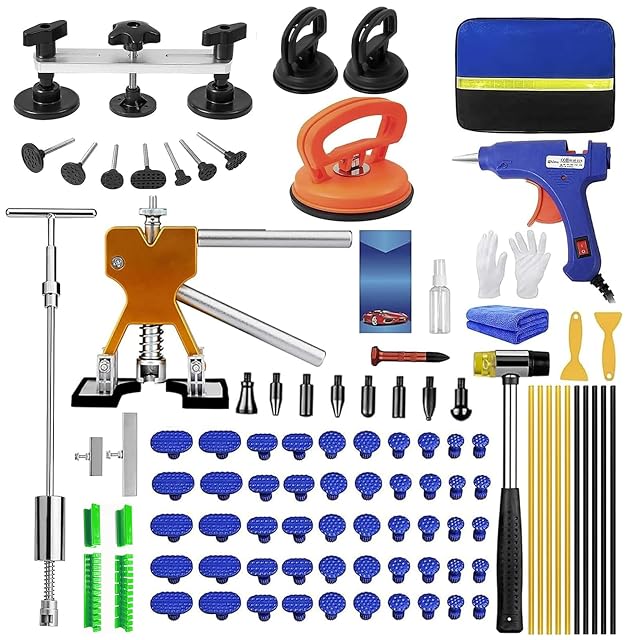
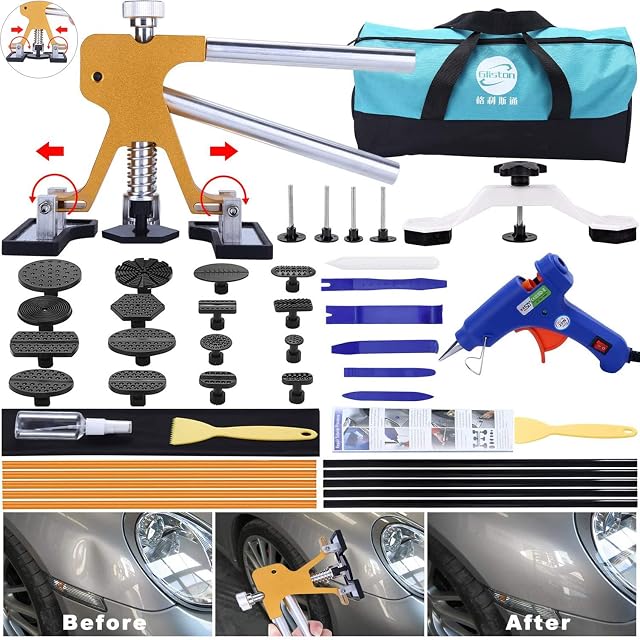
A golden dent lifter adjustable for dents from 0.2 to 5.3 inches, a bridge puller for 0.2 to 3.54 inches, a stainless 2-in-1 slide hammer usable long or short, three suction cups (one large, two small), 50 solid puller tabs, 6 bridge tabs, 2 grooves of puller lines and 4 puller lines, a hot glue gun with 20 glue sticks, an air wedge pump, a plastic shovel, 8 tap-down pens, a rubber hammer, an empty bottle, a cloth, a reflective board, a pair of gloves and a storage bag. 3,175 g (112 oz), 358 × 246 × 152 mm (14.1 × 9.69 × 5.98 in). $55.90.
It is the only kit on this shelf that publishes the dent sizes it covers
“Our golden dent lifter allows you to adjust the width and height to accommodate different dent size from 0.2” to 5.3”. And the bridge dent puller can also be adjusted to repair dents from 0.2” to 3.54”.”
Two ranges, in inches, for two different tools.
| Kit | Dent size range published |
|---|
| This kit | lifter 0.2–5.3 in, bridge 0.2–3.54 in |
| GLISTON | relative only — “1 cm (0.4 in) more height, 3.8 cm (1.5 in) more width” than an older version |
| BESTGLOAL | by category — lifter small, bridge medium, T-bar large |
| Reboun · QIUBC · HORFUTY · Tiantanghu · Ofeace, published | none |
That is the figure a buyer actually needs, because the question is not how many pieces are in the box but whether the puller spans the dent. A bridge puller has to bear on sound metal either side; a dent wider than its reach cannot be pulled with it at all.
Five point three inches is 135 mm on the lifter, which covers a door ding and most hail damage. Nought point two inches is 5 mm, which is the small end — a sharp ding from a stone, and the kind of dent the shelf’s introduction warns about for a different reason.
And it is the only kit here with a reflective board
A reflector board is how paintless dent repair is actually done.
A dent is invisible when you look at the panel; it appears when you look at the reflection of a straight line across it. A board with printed lines held over the panel turns an invisible depression into a visible kink in a line, and it is the only way to know when to stop pulling — because the failure mode of glue pulling is over-pulling, which makes a high spot that then needs hammering back down.
Which is what the 8 tap-down pens and the rubber hammer are for. The published VEVOR rod set on this shelf states the same thing: it includes “a knock-down tool, for the high spots a push creates.”
So of the nine items on this shelf, this is the one that supplies the whole professional loop: pull, read, tap down, read again. No other listing mentions a reflector at all.
Solid tabs rather than hollow ones, which is a distinction nobody else makes
“Our solid tabs are more durable than most hollow tabs on the market. And 50 pcs tabs of different sizes and shapes are great for repairing various dents.”
A glue tab takes the entire pull load through a plastic stem. A hollow stem flexes and then splits — usually on the pull that was going to work — and a split tab leaves its glue on the panel.
Fifty tabs is also the count, which matters because tabs are consumed: glue has to be scraped off and a tab that has been heated repeatedly distorts.
| Kit | Tabs | Glue sticks |
|---|
| Reboun | 98 | 40 |
| This kit | 50 solid + 6 bridge | 20 |
| GLISTON | 16 lifter sizes + 5 bridge sizes, count not stated | 10 |
| BESTGLOAL · Ofeace, published | not stated | not stated |
But the piece count is two-thirds consumables, and the reference disagrees with the title
The title says 117 PCS. The published reference says 107 pcs Dent Removal Tools.
Ten pieces between two numbers on the same listing. The itemized contents list adds up to the higher figure, so 117 is the better reading — and it is worth checking on arrival, because the only way to know is to count.
More useful is what the 117 is made of. Of the itemized contents, 50 tabs + 6 bridge tabs + 20 glue sticks = 76 pieces, which is 65% consumables. The tools are the lifter, the slide hammer, the bridge, three suction cups, the glue gun, eight tap-down pens, a hammer, a shovel, a board, a wedge pump and a bag — about twenty items.
The published Ofeace page on this shelf says it plainly about its own 120: “a hundred and twenty pieces is mostly tabs and glue sticks.” That is true of every big number on this shelf, and this is the kit whose itemization lets you prove it.
“1 x air wedge pump.”
An air wedge is an inflatable bladder pushed into a gap and pumped up to open it — a door skin from its frame, a trim panel from a clip line. It is not a dent tool: it is what creates access behind a panel, which is what the rod method needs.
The published VEVOR rod set on this shelf has that limitation written into its page: rods “require access behind the panel — which many modern panels do not allow”. An air wedge is how that access is made, and it is here in a glue kit rather than in the rod kit.
Three suction cups, which are the crude end of the same box
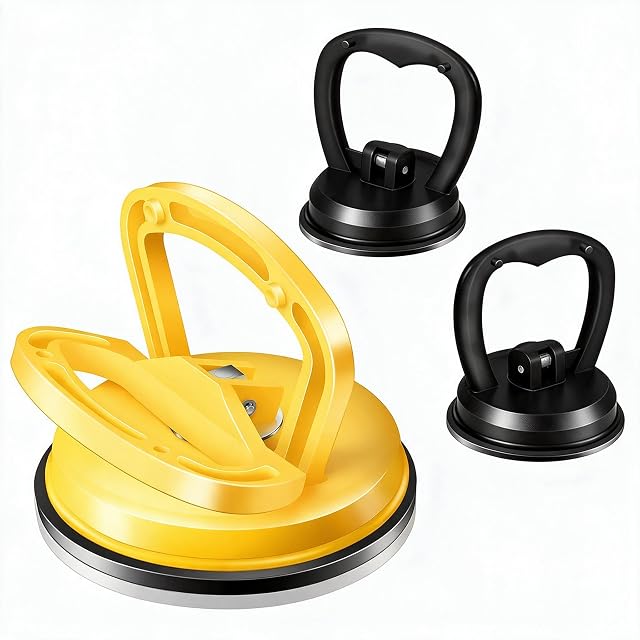
“Three suction cups are quite easy to use, make dents disappear from your beloved car.”
No diameter and no suction rating is published for any of the three. The HORFUTY and Tiantanghu kits on this shelf — which are nothing but suction cups — publish both: a 4.5-inch large cup and two 2.2-inch small ones, at 130/80 lb and 110/77 lb respectively.
A suction cup pulls a large shallow dent and cannot touch a small sharp one. In a kit that also contains a lifter, a bridge and a slide hammer, it is the tool you reach for first because it needs no glue — and the one that works least often.
What is not published
No dent limit. This is the omission the introduction cares most about: “it has clear limits that the honest kits state… a creased dent, a dent on a body line, or one with cracked or flaking paint does not” respond. GLISTON states it (“not suitable for corners or creases”); HORFUTY and Tiantanghu state it; this does not.
No suction cup diameters or ratings. No glue temperature or working time, where BESTGLOAL publishes a 3-to-5-minute heat-up. No tab shapes beyond “different sizes and shapes”. No slide hammer weight. No reflector board dimensions.
At $55.90 it publishes the two ranges that decide whether a puller fits, and the board that tells you when to stop.
Availability
On sale at around $56 on the American Amazon store at the time of checking.
Prices and availability are what Keepa reported on the date this page was updated; both move.
Prices quoted in this text were read on 6 October 2026. The live price is at the top of the page.