What you are getting
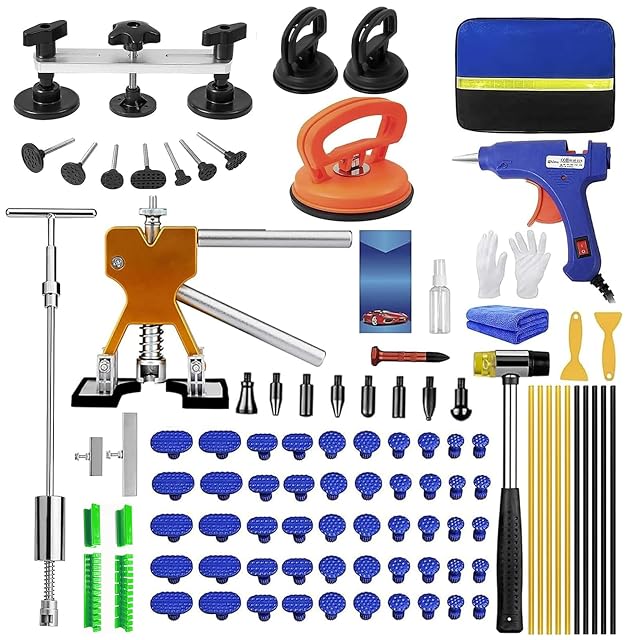
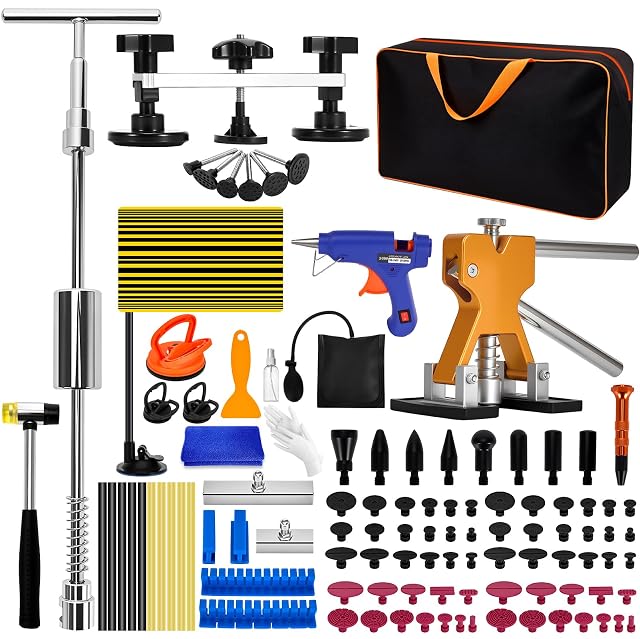
A 45-piece paintless dent repair kit: a golden dent lifter taking 16 different tab sizes, a plastic bridge dent puller with 5 tab sizes, a hot glue gun with a built-in fuse, 10 strong-stickiness glue sticks and 5 pry tools. Padded rubber feet, and components stated as inspected and certified for Rockwell hardness. $35.99.
It states what it cannot fix, which the introduction makes the test
“(Tip: This tool not suitable for corners or creases)”
Seven words in brackets at the end of the second bullet, and they are the most valuable thing on this shelf.
The introduction: “Paintless dent removal works by pulling metal back through its own elasticity, and it has clear limits that the honest kits state: a smooth, shallow dent with intact paint responds; a creased dent, a dent on a body line, or one with cracked or flaking paint does not.”
| Kit | What it says about its limits |
|---|
| This kit | “not suitable for corners or creases” |
| HORFUTY · Tiantanghu | “forbidden to use when the car paint is cracked or damaged” |
| BESTGLOAL | “remove 99% of your car’s dents in 30 minutes” |
| Reboun | “handles any dent type” |
| VEVOR · QIUBC · Ofeace, published | nothing |
Three of the nine items on this shelf state a limit. Two state the opposite. The reason creases and corners matter: a crease is metal that has been stretched past its elastic range and will not return — pulling it harder tears paint off the peak of the crease. A corner or body line is formed metal with built-in stiffness, which resists the pull and transmits it to the flat panel beside it, so you move the wrong metal.
Knowing that before you glue a tab on is worth more than twenty extra tabs.
And it has no slide hammer, which is also a decision
The introduction splits the category: “Kits divide into bridge pullers, which push against the panel to lift a glued tab in a controlled way, and slide hammers, which are faster and less forgiving.”
| Kit | Lifter | Bridge | Slide hammer |
|---|
| This kit | yes | yes | no |
| BESTGLOAL · VEVOR · Reboun | yes | yes | yes |
| HORFUTY · Tiantanghu · QIUBC | — | — | — |
| Ofeace, published | T-handle | — | — |
A slide hammer pulls by inertia: a weight runs up a shaft and hits a stop, and the tab gets a sharp impulse. It moves metal nothing else will and it is impossible to meter — the published Ofeace page states the general preference, that “a T-handle puller is more controllable than a slide hammer for a beginner”.
So this kit is both pullers that screw rather than strike: the lifter squeezes against its own feet, the bridge bears on the panel either side. Both are slow and both can be stopped at any point, which is what a first attempt needs.
“The pops a dent bridge kit with 5 different size tabs for dents, the dent lifter can choose 16 different size tabs.”
That is more useful than a piece count. A glue tab has to be smaller than the dent and larger than its deepest point — too small and it pulls a pimple in the middle, too large and it bridges the dent and lifts the sound metal round it.
Sixteen choices on the lifter is a fine ladder. Compare the published Ofeace kit, which offers “tabs for small, medium and large dents” — three ranges — and the VEVOR kit here, which has 50 tabs in unspecified “sizes and shapes”.
What is not published is how many tabs of each size, or the total. Forty-five pieces minus a glue gun, 10 glue sticks, a bridge, a lifter and 5 pry tools leaves about 27 for tabs across 21 sizes, which cannot be more than one or two of each.
Ten glue sticks, which is the smallest supply on this shelf
The introduction: “The consumable is the glue, and it is temperature-sensitive in both directions.”
| Kit | Glue sticks |
|---|
| Reboun | 40 |
| VEVOR | 20 |
| This kit | 10 |
| BESTGLOAL · Ofeace, published | not stated |
Ten sticks is a few dents. Each pull uses a bead, each failed pull uses another, and glue also has to be replaced when it has been heated and cooled in the gun too many times.
The buying advice for this shelf is about the same consumable: “warm the panel to room temperature before pulling. Glue that fails to hold in a cold garage is the single most common reason these kits get returned.” Ten sticks does not leave much room for learning that lesson.
The glue gun has a fuse, which no other listing here mentions
“Glue gun built-in fuse and makes it safer.”
A hot glue gun is a mains heating element with no thermostat on the cheap ones. A fuse is the difference between a gun that dies and a gun that keeps heating, and it is the only safety feature stated about a glue gun anywhere on this shelf — the BESTGLOAL kit publishes a 3-to-5-minute heat-up instead, which is a performance figure.
Rockwell hardness, certified for the accessories
“Car dent removal kit accessories are very strong and durable because all of them was meticulously inspected and certified for Rockwell Hardness.”
No figure, and no scale — HRC and HRB are different ranges and neither is given. So it is the name of a test rather than a result.
It is still the only hardness claim on this shelf. On this site’s screw extractors shelf, where four of twelve items publish an actual HRC number, the same claim appears with figures attached — which is what this one would need to mean anything.
What is not published
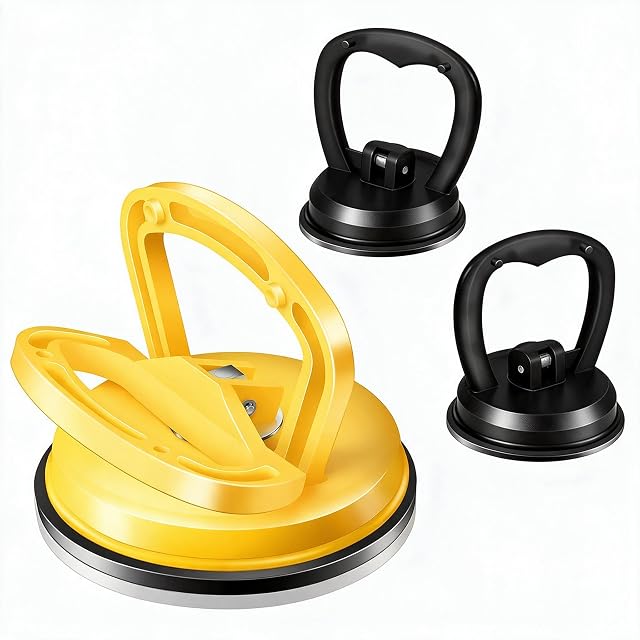
No dent size range, where VEVOR publishes 0.2 to 5.3 in. The “1 cm more height and 3.8 cm more width” figures are improvements over an unnamed older version, not absolute reaches. No tab count. No hardness figure or scale. No glue temperature. No reflective board, which only VEVOR supplies and which is how a pull is judged. No tap-down tool, which VEVOR and Reboun both have and which a high spot needs. No suction cup.
At $35.99 it is the kit that tells you what it will not do, with the gentler of the two puller types and ten sticks of glue.
Availability
On sale at around $36 on the American Amazon store at the time of checking.
Prices and availability are what Keepa reported on the date this page was updated; both move.
Prices quoted in this text were read on 6 October 2026. The live price is at the top of the page.