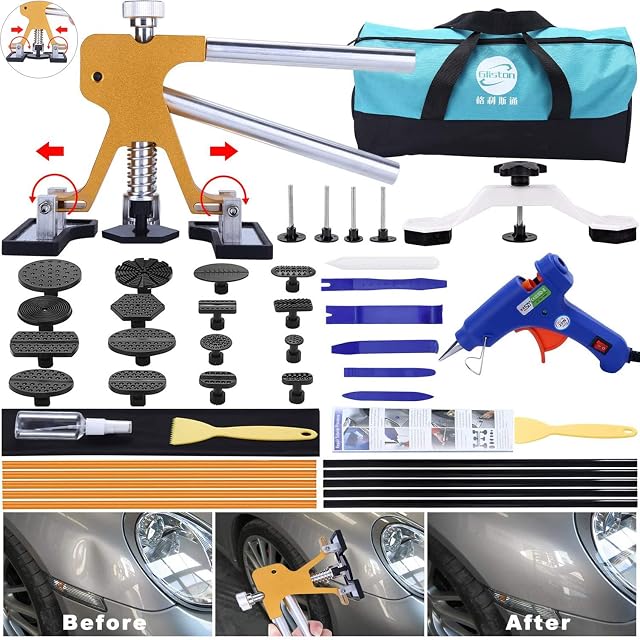
What you are getting
A 97-piece kit with a golden lifter for small dents, a bridge puller for medium ones and a T-bar slide hammer for large ones — the T-bar also disassembling into a short puller — a hot glue gun that heats and releases glue in 3 to 5 minutes, high-viscosity glue sticks, rubber-bottomed pullers and a detailed instruction manual. $44.99.
It assigns a puller to a dent size, which is the clearest guidance on this shelf
“Gold Lifter is suitable for small dents. The Bridge Puller is fit for medium dents. T-Bar Puller is used to repair Large dents. Also, it can be disassembled into a short T-bar puller for use.”
Three tools, three jobs, stated. No other kit on this shelf does that in plain words — the VEVOR kit publishes numbers instead (lifter 0.2–5.3 in, bridge 0.2–3.54 in), which is more precise and less immediately useful; the Reboun kit lists the same three pullers and says they handle “any dent type”.
Why the assignment is right: a lifter squeezes against its own two feet, so its reach is small and its control is total. A bridge bears on the panel either side of the dent, which covers a wider span. A slide hammer has no reaction point at all — it pulls against inertia — so it is the only one that can move a large dent, and the introduction’s warning applies to it: slide hammers are “faster and less forgiving.”
The disassembly into a short T-bar is the detail that is genuinely useful: a long slide hammer will not fit inside a door shut or under a wheel arch, and a short one will.
And it is the only kit here that publishes a glue gun heat-up time
“The hot glue gun has the features of rapid heating, which can heat and release glue without a drop in 3-5 minutes.”
Three to five minutes, and “without a drop” — meaning it reaches working temperature and stays there rather than cycling.
The introduction makes glue the critical variable: “The consumable is the glue, and it is temperature-sensitive in both directions.” A gun that has not reached temperature lays glue that skins before the tab is placed; a gun that overshoots cooks it and the bond fails on the pull.
Of the nine items on this shelf, the only other published fact about a glue gun is the GLISTON kit’s built-in fuse, which is a safety feature rather than a performance one. No kit on this shelf publishes a glue temperature.
The four-step method is published, which two kits here manage
“1. Clean the dent surface and apply a hot glue stick on the puller tab. 2. Put the puller tab on the auto dent and wait a few minutes. 3. Place the lifter puller to pull up the dent. 4. After the dent is out, spray alcohol on the tab and use a scraper to clean the glue.”
Four steps with the two that get skipped written in.
“Wait a few minutes” is step two, and it is the one beginners rush. Hot glue holds when it has cooled and set; pulling at thirty seconds tears the tab off and leaves the glue. The published Ofeace page describes the same method without the timing.
Alcohol and a scraper is step four. Glue left on paint is removed with isopropyl alcohol, which releases the bond without attacking clear coat — and not with a blade, and not with petrol. The VEVOR kit on this shelf publishes the identical four steps; nothing else does.
Neither kit says what strength of alcohol, and neither supplies any. The Reboun kit includes a spray bottle for it.
But it claims ninety-nine per cent of dents in thirty minutes
“Our car dent repair tools can remove 99% of your car’s dents in 30 minutes.” And: “you can say goodbye to dents in just 30 minutes!”
The introduction: “it has clear limits that the honest kits state: a smooth, shallow dent with intact paint responds; a creased dent, a dent on a body line, or one with cracked or flaking paint does not.”
| Kit | Claim or limit |
|---|
| GLISTON | “not suitable for corners or creases” |
| HORFUTY · Tiantanghu | “forbidden when the paint is cracked or damaged” |
| This kit | “99% of your car’s dents in 30 minutes” |
| Reboun | “handles any dent type” |
| VEVOR · QIUBC · Ofeace, published | nothing |
Ninety-nine per cent is a number without a method behind it, and it is contradicted inside the same category by three listings on this shelf. The thirty minutes is more defensible: a single shallow dent, glued, pulled and cleaned, is about half an hour of work once you know what you are doing.
What the figure does is set an expectation that the first attempt will not meet. The buying advice exists for the same reason: “glue that fails to hold in a cold garage is the single most common reason these kits get returned.”
Ninety-seven pieces, with no breakdown
No tab count, no glue stick count, no tab sizes.
| Kit | Pieces | Tabs | Sticks |
|---|
| Reboun | 190 | 98 | 40 |
| VEVOR | 117 | 56 | 20 |
| This kit | 97 | — | — |
| GLISTON | 45 | 21 sizes | 10 |
Two kits on this shelf itemize and two do not. On the two that do, consumables are 65 to 73% of the count — so 97 pieces is probably in the region of 60 to 70 tabs and sticks and about 30 tools, which is an inference and not a figure.
The published Ofeace page states the general case: “a hundred and twenty pieces is mostly tabs and glue sticks.”
Rubber-bottomed pullers, and glue that comes off whole
“The bottom of the car dent suction puller is made of rubber and will not damage the original paint… the hot melt can be wholly removed without damaging the paint.”
Both claims are standard across this shelf and both matter. A lifter sits on paint under load and will mark it without a rubber foot; hot melt glue formulated for this job releases cleanly, and ordinary craft glue does not.
What the listing does not say is what the glue is, or its working temperature — which is the variable the whole method depends on.
What is not published
No tab count or sizes. No glue stick count. No glue temperature. No dent size range in figures, where VEVOR publishes two. No reflective board, which only VEVOR supplies and which is how a pull is judged. No tap-down tool, which a slide hammer makes necessary and which VEVOR and Reboun both include. No statement of what it cannot fix. No alcohol or scraper, despite both appearing in its own published method.
At $44.99 it tells you which puller is for which dent and how to use it, and promises more than the method can do.
Availability
On sale at around $45 on the American Amazon store at the time of checking.
Prices and availability are what Keepa reported on the date this page was updated; both move.
Prices quoted in this text were read on 6 October 2026. The live price is at the top of the page.