What you are getting
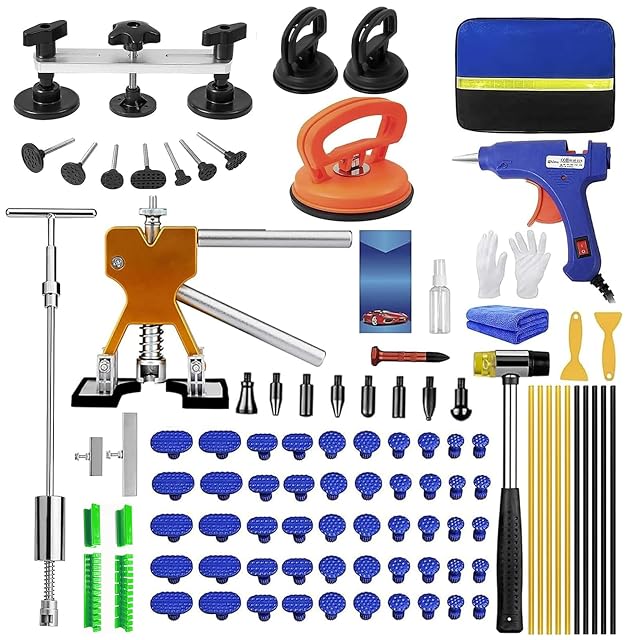
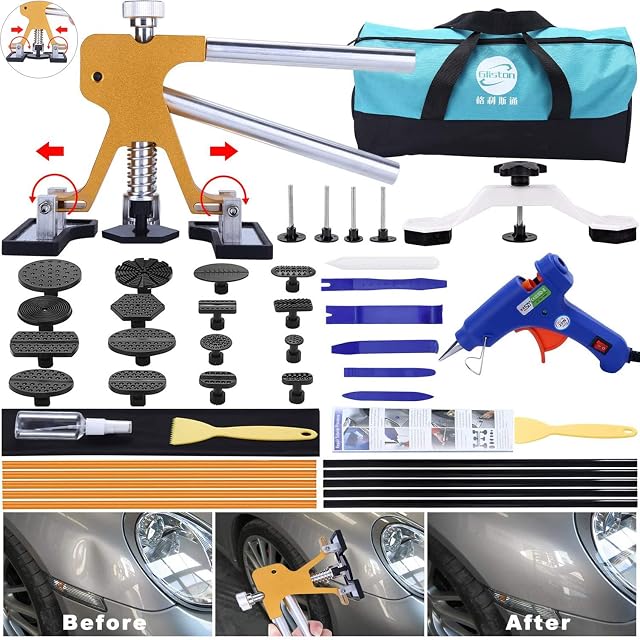
A 190-piece kit: a golden dent lifter, a bridge puller, a 2-in-1 slide hammer T-bar, large and mini suction cups, 98 glue tabs, 40 glue sticks, a hot glue gun, tap-down tools, a rubber hammer, scrapers, a spray bottle, a microfibre cloth, three pairs of gloves, a storage bag, and 7 trim removal tools as a bonus. Aluminum alloy tools with soft rubber bottoms. $59.98.
Ninety-eight tabs and forty sticks is the largest consumable supply on this shelf
| Kit | Glue tabs | Glue sticks |
|---|
| This kit | 98 | 40 |
| VEVOR | 50 solid + 6 bridge | 20 |
| GLISTON | 21 sizes, count not stated | 10 |
| BESTGLOAL · Ofeace, published | not stated | not stated |
The introduction names the consumable: “The consumable is the glue, and it is temperature-sensitive in both directions.”
Forty sticks is the figure that matters, because glue is what gets used up and what fails. Each pull takes a bead; each failed pull takes another; and the buying advice on this shelf says where the failures come from — “glue that fails to hold in a cold garage is the single most common reason these kits get returned.”
Ninety-eight tabs is the other half. Tabs are semi-consumable: glue has to be scraped off them, and one that has been heated and cleaned many times distorts and stops sitting flat. A kit with a hundred of them is a kit you can learn on.
But 138 of the 190 pieces are those consumables
98 + 40 = 138, which is 73% of the piece count.
The remaining 52 pieces are the tools: lifter, bridge, slide hammer, two suction cups, glue gun, tap-downs, hammer, scrapers, bottle, cloth, three pairs of gloves — six pieces on their own — bag, and seven trim tools.
The published Ofeace page on this shelf makes the point about its own 120: “a hundred and twenty pieces is mostly tabs and glue sticks.” It is more true here than anywhere else on the shelf, and it is not a criticism of the kit — 138 consumables for $59.98 is the reason to buy it. It is a reason not to read 190 as 190 tools.
| Kit | Pieces | Consumable share |
|---|
| This kit | 190 | 73% |
| VEVOR | 117 | 65% |
| Ofeace, published | 120 | “mostly” |
And it claims it handles any dent, which three kits here contradict
“Handles any dent type — from door dings to hail damage — with ease. Never worry about mismatched tools for your repair.”
The introduction is unambiguous that this is not how the method works: “it has clear limits that the honest kits state: a smooth, shallow dent with intact paint responds; a creased dent, a dent on a body line, or one with cracked or flaking paint does not.”
On this shelf, the GLISTON kit states “not suitable for corners or creases” and the HORFUTY and Tiantanghu suction cups state that use is “forbidden when the car paint is cracked or damaged”. The BESTGLOAL kit makes the same kind of claim as this one, at 99%.
Three pullers do cover three dent sizes, which is what the bullet is really about — lifter for small, bridge for medium, T-bar for large. What no combination of tools covers is a crease, because the metal has been stretched past its elastic limit and will not come back.
Three pullers, including the one the introduction calls less forgiving
“Golden Dent Lifter, Bridge Puller, and 2-in-1 Slide Hammer T-Bar Puller.”
The introduction: “Kits divide into bridge pullers, which push against the panel to lift a glued tab in a controlled way, and slide hammers, which are faster and less forgiving.”
| Kit | Lifter | Bridge | Slide hammer |
|---|
| This kit · BESTGLOAL · VEVOR | yes | yes | yes |
| GLISTON | yes | yes | no |
| Ofeace, published | T-handle | — | — |
A slide hammer is the tool for a large shallow dent that a screw-down puller cannot shift, and it is the tool most likely to leave a high spot — which is why the tap-down tools and the rubber hammer in this kit are not optional extras.
What is missing beside them is the way to see the high spot: only the VEVOR kit on this shelf supplies a reflective board, which is how a dent is read in the reflection of a straight line.
“Durable, high-quality aluminum alloy and soft rubber bottoms protect your car’s original finish.”
Of the nine items on this shelf, the VEVOR kit names stainless steel for its slide hammer, the GLISTON kit claims a Rockwell certification with no figure, the Tiantanghu cups name ABS and natural rubber with a metal core, and this names aluminum alloy.
Aluminum on a dent lifter is a sensible choice — it is a tool held against paint and squeezed, so light and non-marking matters more than ultimate strength. On a slide hammer, where the load is impact, it is a less obvious one, and the listing does not say which parts are which.
“BONUS 7PCS Trim Removal Tools.”
Trim removal tools are the plastic levers that take a door card, a sill trim or a bumper off without breaking its clips — and on this site they have a shelf of their own.
They are a genuine inclusion here rather than padding, for the same reason the VEVOR kit includes an air wedge pump: glue pulling works from outside, and the moment a dent needs access from behind, a panel has to come off. Seven levers is a basic set for that.
What is not published
No dent size range, where VEVOR publishes 0.2 to 5.3 in for its lifter and 0.2 to 3.54 in for its bridge. No tab shapes or sizes, only the count of 98. No glue temperature or working time. No suction cup diameters or ratings, where the two cup-only kits on this shelf publish both. No reflective board. No slide hammer weight. No statement of what it cannot fix.
At $59.98 it is the most expensive kit on this shelf and the one with the most to practice with, and it tells you nothing about where to stop.
Availability
On sale at around $60 on the American Amazon store at the time of checking.
Prices and availability are what Keepa reported on the date this page was updated; both move.
Prices quoted in this text were read on 6 October 2026. The live price is at the top of the page.