What you are getting
An electric hydraulic car jack rated 5.0 tons / 11,023 lb, lifting 6.1 in to 17.7 in (155–450 mm) in about 2 minutes with an automatic stop at full height; an electric impact wrench at 450 N·m with two double-ended sockets covering 17/19 mm and 21/23 mm; a tire inflator with a pressure display; hidden toolboxes in both sides; a 13-foot lead powered from a 12 V cigarette lighter or the car battery; and three spare fuses, stated TUV and UL certified. The shipping record gives 8,165 g (288 oz) and 371 × 340 × 175 mm (14.6 × 13.4 × 6.89 in). $95.99.
Five metric tons is the highest rating on this shelf, and 155 mm (6.10 in) is the highest entry
Both ends of that sentence matter.
| Jack | Rated | Minimum | Maximum |
|---|
| This jack | 5 t / 11,023 lb | 155 mm (6.10 in) | 450 mm (17.7 in) |
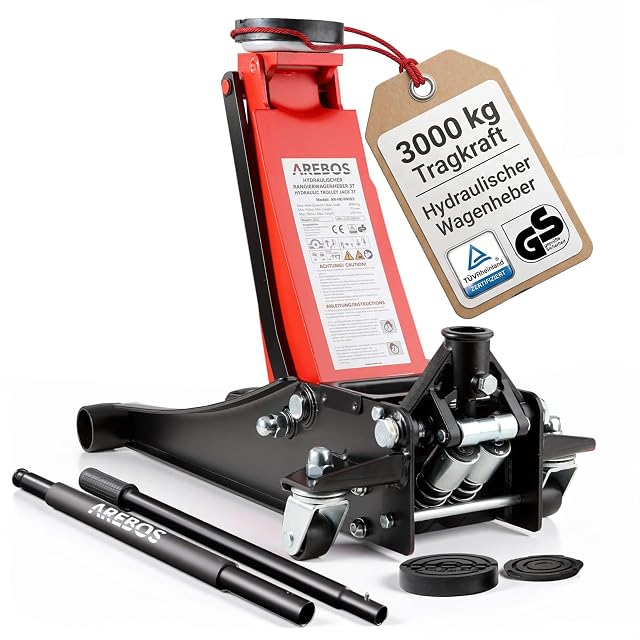
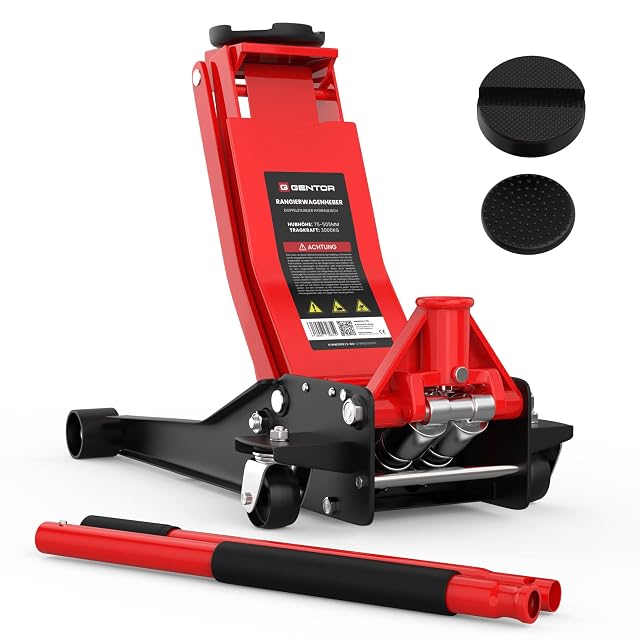
| Arebos · Gentor · Hammerhart, published | 3 t | 75 mm (2.95 in) | 505 mm (19.9 in) |
| Stix, published | 2.5 t | 85 mm (3.35 in) | 365 mm (14.4 in) with adapter |
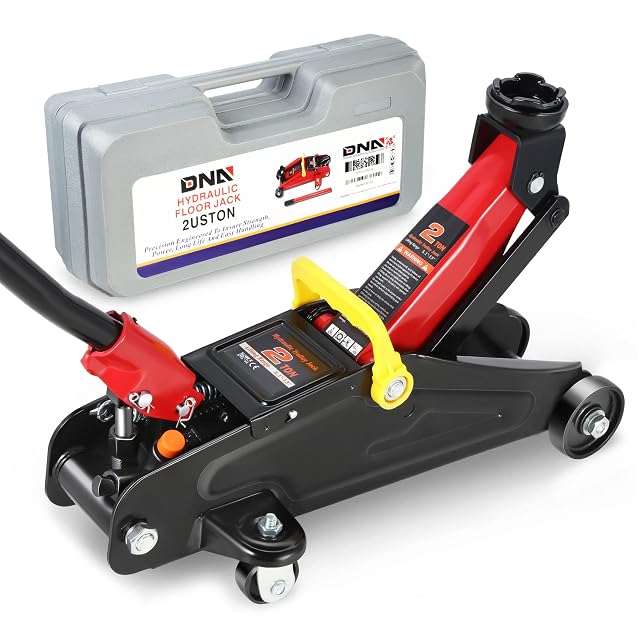
| DNA Motoring | 2 ton (4,000 lb) | 130 mm | 330 mm (13 in) |
| Maxority | 2-Ton (4,400 lb) | not published | not published |
| Unitec, published | 2 t | not published | not published |
The buying advice on this shelf: “measure the gap under your own jacking point before choosing. An 85 mm (3.35 in) saddle is useless on a car with 80 mm (3.15 in) of clearance.”
One hundred and fifty-five millimeters is more than double the 75 mm of the three low-profile jacks published here. It is six inches of body standing under the car before anything rises — which is why this is sold for “autos, sedans, SUVs, trucks” and why, on a low car, it will simply not go under the jacking point.
The 5-metric ton rating is the other side of the same design. The need card here: “The stated capacity has to exceed by a wide margin the load actually lifted, which is only part of the vehicle’s weight.” Five metric tons on one corner is a very wide margin for a car and the right order for a pick-up or a van.
It raises the car on its own, which is the actual argument
“Say goodbye to tedious manual operations. Our electric jack for cars only takes about 2 minutes to reach a maximum height (17.7”). When the car jack reaches its MAX. Height, it will automatically stop lifting to ensure security.”
Two minutes unattended against perhaps forty pump strokes. Four of the five published jacks on this shelf sell a dual-cylinder or Quicklift pump on exactly that complaint — the strokes at the fourth corner — and this removes the strokes.
The automatic stop at maximum height is a published safeguard on a powered ram. It is a limit switch at the top of travel, not a load limit — the DNA Motoring jack on this shelf is the one that publishes an overload release valve, which is a different protection entirely.
And VEVOR publishes two conditions that are easy to skip: “The jack must be used on flat surfaces and be placed perpendicular to your car.” A powered jack rising on a camber, or cocked to the sill, is exactly the arrangement that puts side load on a ram.
And this site’s refusal applies to it in full
The introduction: “The refusal is the important part: a jack raises the car, and axle stands hold it. Nothing on this site describes working under a vehicle supported by a jack alone.”
A powered jack with an automatic stop and 5 metric tons on the plate changes nothing about that. A hydraulic ram holds its load through a valve and a seal; both are wearing parts, and neither is a mechanical stop. The axle stands shelf is the other half of any job that puts a person under a car.
The one listing on this shelf that prints the same refusal is the DNA Motoring jack. This one calls itself “a lifesaver during roadside emergencies”, which is a fair description of a wheel change and not of anything underneath.
The impact wrench is 450 N·m, which is more than any wheel needs
“With Max. Torque 450 N.M, the electric impact wrench can screw/unscrew in just a few seconds. 2 pcs sleeves are available for screws of 4 sizes (17/19 mm & 21/23 mm).”
Car wheel nuts are tightened to roughly 110 to 140 N·m. Four hundred and fifty is the loosening figure that matters, because a nut seized or over-tightened by a tire shop needs far more to come off than it took to go on.
Two double-ended sockets covering 17, 19, 21 and 23 mm (0.91 in) is the common European and Asian range. No 15/16 or 13/16 inch is listed, and nothing imperial, which on some American vehicles is the size needed.
There is also a caution the listing supplies itself: “Please select the right sleeve, and hold the power button until the screw is pulled out.” A 450 N·m gun with the wrong socket rounds a nut, and this site’s impact wrenches shelf is explicit that an impact socket, not a chrome one, belongs on a gun like this. The two sockets supplied are not described as impact sockets.
Torque is one-way here in another sense: a gun with a single maximum figure and no setting cannot be used to tighten to a specification. Wheel nuts are a torque-wrench job on the way back on, and this site has a torque wrenches shelf for it.
The inflator has a gauge, which is what makes one usable
“With a tire inflator pump installed in the electric hydraulic car jack… Equipped with a tire pressure display, you can monitor the tire pressure while pumping.”
Hidden toolboxes on both sides hold the hose and the needles.
No maximum pressure is published, which is the figure that decides whether it will do a van tire — the published combined packs on this site’s jump starters shelf state 120, 150 and 160 PSI. No duty cycle either, and no auto-stop at a set pressure: the display lets you watch, and the stopping is done by hand.
Twelve volts, two ways, and three spare fuses
“can be powered by a 12V cigarette lighter or car battery and equipped with a long 13 feet power cord… We also provide you with three spare fuses, and our fuses are TUV, and UL-certified.”
Thirteen feet of lead reaches any corner from the socket inside the car, which is the practical reason for the length.
Two things to read carefully. First, a cigarette-lighter circuit is usually fused around 10 to 15 A, which is 120 to 180 W — so the heavier work is the reason battery clamps are offered as the alternative. Second, three spare fuses in the box is a maker telling you that fuses blow.
And the certification claim is precise about its subject: “our fuses are TUV, and UL-certified”. It is a statement about the fuses, not about the jack. The published Hammerhart jack on this shelf names TÜV Rheinland and GS certification to EN 1494 for the jack itself, and remains the only item here to name a standard for the lifting equipment.
What is not published
No standard or certification for the jack, only for its fuses. No current draw in amps, so whether a cigarette socket will carry it is unknown. No inflator maximum pressure and no duty cycle. No saddle pad, where three published jacks ship two. No castors — this is a powered body, not a trolley, and nothing is said about moving it. No overload valve. No warranty. No weight from the maker; the 8,165 g above is the shipping record, and the introduction notes that “no maker on this shelf publishes a weight”.
At $95.99 it is three roadside tools on one 12 V lead, with the highest rating and the highest entry height on this shelf.
Availability
On sale at around $96 on the American Amazon store at the time of checking.
Prices and availability are what Keepa reported on the date this page was updated; both move.
Prices quoted in this text were read on 6 October 2026. The live price is at the top of the page.