What you are getting
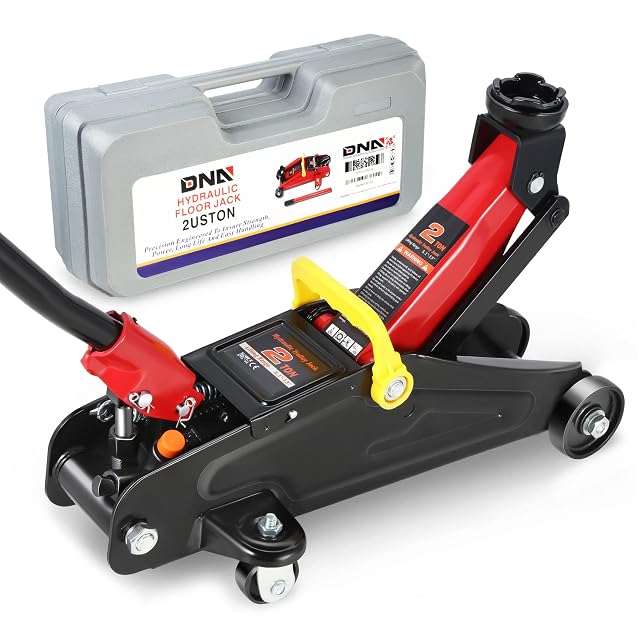
A hydraulic trolley jack rated 2-Ton (4,400 lb), described as low profile, with a lug wrench and a blow-mold carrying case. $69.99.
Its “2-Ton” is four hundred pounds more than the other 2-ton jack here
“This Floor Jack Kit, with its 4,400 lbs lifting capacity.”
Four thousand four hundred pounds is 1,996 kg (4400.4 lb) — two metric tons. The DNA Motoring jack on this shelf publishes “2 ton (4,000 lb)”, which is 1,814 kg (3999.2 lb), the American short ton doubled.
| Jack | Stated | In pounds | In kilograms |
|---|
| DNA Motoring | 2 ton | 4,000 lb | 1,814 kg |
| This jack | 2-Ton | 4,400 lb | 1,996 kg (4400.4 lb) |
Same two words, 181 kg (399 lb) apart, and the pounds are the only way to see it. On this shelf that gap is worth reading, because the need card says the stated capacity “has to exceed by a wide margin the load actually lifted, which is only part of the vehicle’s weight” — the margin is the whole point, and 181 kg (399 lb) of it is real.
The five jacks published earlier on this shelf are rated in metric tons — 2 t, 2.5 t, 3 t — which leaves no room for the ambiguity.
But it publishes neither saddle height, which is the purchase decision
“The low-profile design of this car jack allows it to slide easily under most vehicles with low clearance.”
That sentence is the claim. There is no figure behind it — no minimum saddle height and no maximum lift anywhere in five bullets.
The buying advice for this shelf exists for this exact case: “measure the gap under your own jacking point before choosing. An 85 mm (3.35 in) saddle is useless on a car with 80 mm (3.15 in) of clearance, and the fix afterwards is a pair of ramps you did not plan to buy.”
| Jack | Minimum | Maximum |
|---|
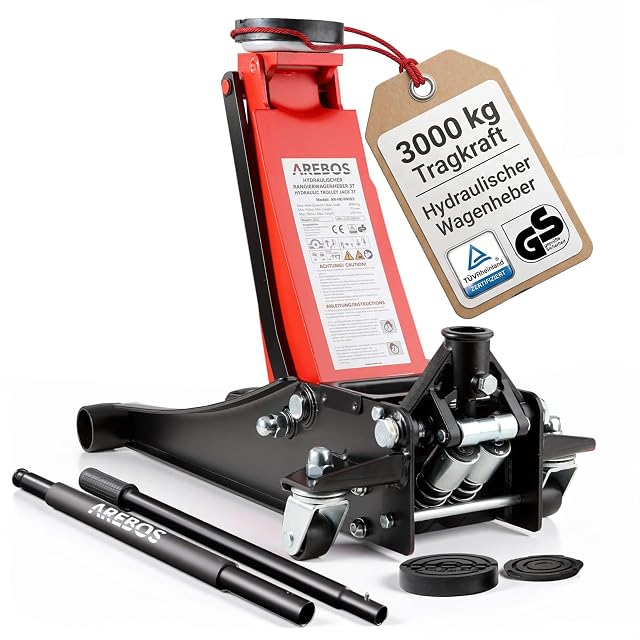
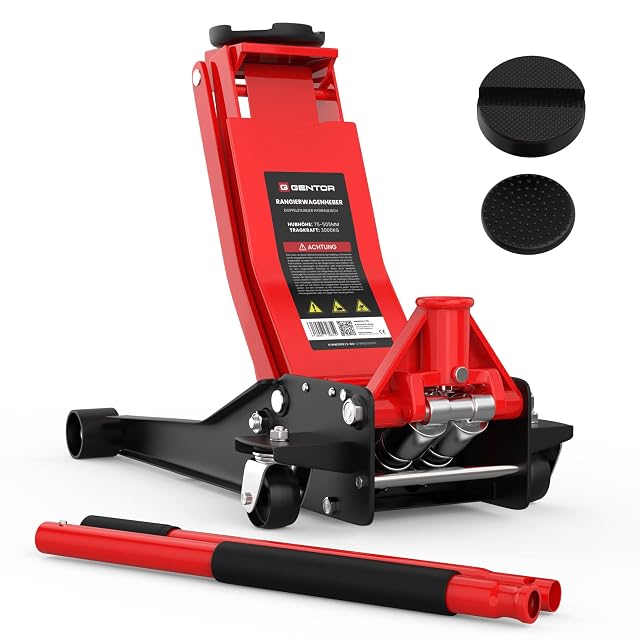
| Arebos · Gentor · Hammerhart, published | 75 mm (2.95 in) | 505 mm (19.9 in) |
| Stix, published | 85 mm (3.35 in) | 365 mm (14.4 in) with adapter |
| DNA Motoring | 130 mm (5.12 in) | 330 mm (13 in) |
| VEVOR electric | 155 mm (6.10 in) | 450 mm (17.7 in) |
| This jack | not published | not published |
| Unitec, published | not published | not published |
Six of the eight jacks here publish a minimum height. This and the published Unitec jack do not, and the word “low profile” is not a measurement — the DNA Motoring jack on this shelf carries the same words at 130 mm (5.12 in), which is 55 mm (2.17 in) above the low-profile jacks published here.
So “most vehicles with low clearance” is unverifiable from the listing, and the only safe way to buy it is to be able to return it.
The lug wrench is the reason the kit exists
“This all-in-one kit, with its 2-ton floor jack, lug wrench, and a convenient carrying case, ensures you’re always prepared for quick tire changes.”
That is a coherent product. Changing a wheel needs three things: something to break the nuts, something to lift the car, and somewhere to keep both. A lug wrench is the one tool the car’s own kit usually supplies in its weakest form — a short folding brace that will not shift a nut done up by an air gun.
No other jack on this shelf includes one. The alternative on this site is the impact wrenches shelf, or a breaker bar and a socket from the socket sets shelf.
The blow-mold case is the other half: a trolley jack loose in a boot rolls, leaks and marks. Three of the eight jacks here publish nothing about storage at all, and the published Unitec jack offers a carry handle instead.
And the model reference says 1T on a 2-ton jack
The reference published for this listing is MAX20011-1T.
That is worth noting without over-reading: a supplier reference often encodes a family rather than a specification, and the capacity stated in the bullets and the title is 2-Ton / 4,400 lb throughout. But on a shelf where the tonnage is the headline figure and the same words mean two different weights, a reference ending -1T is one more reason to confirm the capacity on the tool itself.
No weight, no pump, no pads
The introduction states the first as a rule of the category: “No maker on this shelf publishes a weight.” True here too, and the shipping record gives no mass for this listing either.
No pump action: single or dual cylinder is not stated, where the published Arebos, Gentor and Hammerhart jacks all name a dual or Quicklift system that halves the strokes. On a 2-metric ton jack at the fourth corner of a car, that is the difference a buyer feels.
No saddle pad. The published Stix jack ships two — one flat and one grooved, which is what a pinch weld needs if it is not to fold under a wide saddle. The published Arebos and Gentor jacks each ship two rubber pads. This ships a lug wrench.
And it never states the refusal
Nothing in this listing says what the DNA Motoring jack on this shelf says: that a jack lifts and must not hold.
This site says it instead, at the top of the shelf: “The refusal is the important part: a jack raises the car, and axle stands hold it. Nothing on this site describes working under a vehicle supported by a jack alone.”
For a kit sold on quick tire changes that is the right use anyway — a wheel change does not put anyone under the car — but a kit bought for that will be used for other things.
What is not published
No minimum or maximum saddle height. No weight. No pump action. No saddle pad. No castor count or type. No certification or standard, where the published Hammerhart jack names TÜV Rheinland and GS to EN 1494. No overload valve, which the DNA Motoring jack publishes. No case dimensions. No lug wrench sizes, which decides whether it fits your wheel nuts. No warranty.
At $69.99 it is a wheel-change kit with a case, and the two numbers that decide whether the jack fits under your car are not in it.
Availability
On sale at around $70 on the American Amazon store at the time of checking.
Prices and availability are what Keepa reported on the date this page was updated; both move.
Prices quoted in this text were read on 6 October 2026. The live price is at the top of the page.